Where legend meets landscape
Every place has its stories. Some are documented in history books. Others live in local legend, passed down through generations, embellished by time, impossible to verify but too good to abandon. Anne Boleyn Well in Carshalton belongs to the second category.
Did Anne Boleyn really visit Carshalton? Did she really drink from this well? Historians are skeptical. But the legend persists, woven into the fabric of local identity. And as an artist, I find myself less interested in historical accuracy than in the emotional truth of myth.
Painting from a legendary viewpoint
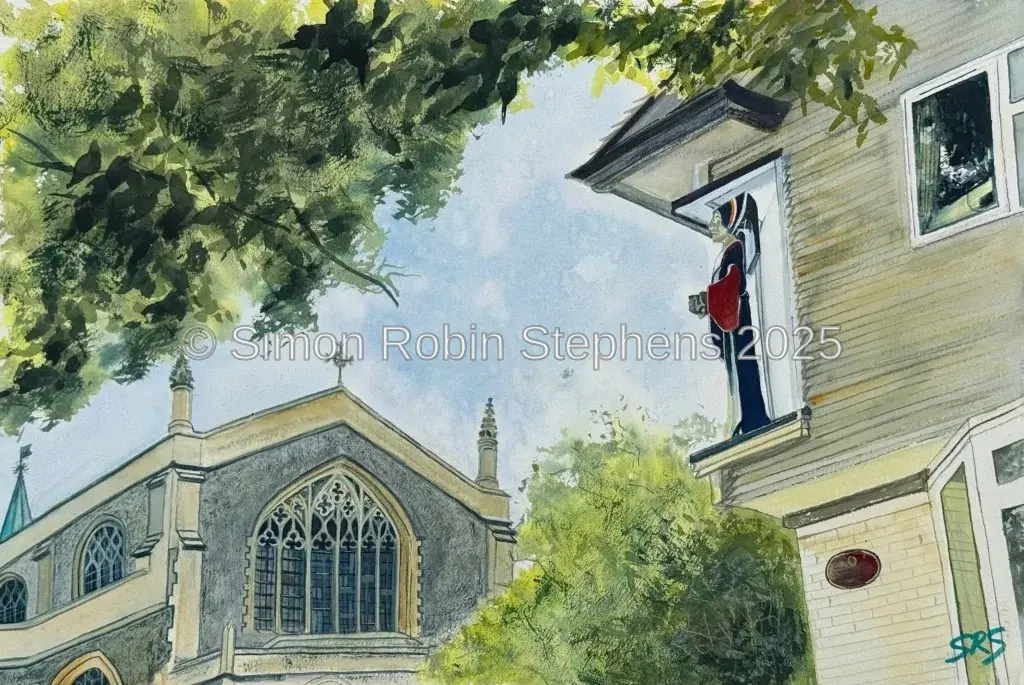
Anne Boleyn Point of View imagines what she might have seen — standing beneath leafy branches, looking toward St Mary Church with its distinctive architecture rising beyond the well. It is a view framed by nature, filtered through time, heavy with narrative weight.
I did not paint this to prove or disprove the legend. I painted it because the idea of Anne Boleyn here — a queen in exile, seeking solace in Surrey countryside, finding brief respite at a healing well — adds depth to how we see this place today.
Why heritage myths matter to artists
As a South London artist focused on local landscapes, I have learned that heritage is not just about facts. It is about the stories we tell ourselves about place. The myths that make us care. The legends that turn ordinary locations into pilgrimage sites.
Whether or not Anne Boleyn actually stood here is less important than the fact that people believe she might have. That belief changes how we interact with the space. We approach it with more reverence, more curiosity, more connection to something larger than ourselves.
Balancing precision and romance
The challenge in painting Anne Boleyn Point of View was honouring both the architectural precision of St Mary Church and the romantic atmosphere of the legend. I wanted the church to be recognisable, accurate, grounded. But I also wanted the foliage, the light, the overall mood to feel slightly timeless — as if this view could belong to any century.
That balance — between documentary and imagination, between precision and poetry — is what makes heritage painting interesting. You are not just recording what is there. You are interpreting layers of meaning, memory, and myth.
Local legends as creative inspiration
The legends of Carshalton — from Anne Boleyn Well to the various stories about the historic ponds and buildings — provide endless creative inspiration. They invite us to see familiar places through multiple lenses: historical, mythological, personal, communal.
When I paint these sites, I am participating in an old tradition: artists have always been interpreters of myth. We visualise stories. We give form to collective imagination. We help keep legends alive not by proving them but by honouring them.
Heritage connects past and present
Standing at Anne Boleyn Well, looking toward St Mary Church, I was acutely aware of temporal layers. The church has stood for centuries. The well, older still. The trees around me, perhaps a century old. The legend, five hundred years and counting. And me, with my watercolours, adding one more layer to the accumulation.
That sense of continuity — of being part of a long conversation between past and present — is what makes painting heritage sites so meaningful. You are not alone. You are in dialogue with everyone who has ever stood here and wondered.
See the painting
You can view Anne Boleyn Point of View in my South London Collection. It captures the view from the well, the architecture of St Mary Church, and the enduring romance of a legend that refuses to be forgotten.
Next time you visit Anne Boleyn Well, pause for a moment. Look through the trees toward the church. Whether or not she was here does not matter. The story is real. The connection is real. And the view is still beautiful.
— Simon Robin Stephens, watercolour artist based in Carshalton, Surrey